


On Monday 10 February 2025, we selected 40 people for the Cumbria Climate Assembly, which met in March and April 2025 for three full day and three evening sessions, to discuss:
Many people in Cumbria feel unheard and unable to influence those who make decisions on climate change action. What can be done about this?
Working with the Westmorland & Furness Council and the Cumberland Council, we recruited these 40 people following a two-stage process, in conformity with the OECD's good practice principles for deliberative processes for public decision making.
Stage 1
8,000 mail invitations were sent to households across Cumbria. These addresses were randomly selected from the Royal Mail database. Each of these addresses received a letter in the post inviting residents to sign up as potential members of the Cumbria Climate Assembly.
The invitation package consisted of a letter and FAQ, and an invitation card as shown below:
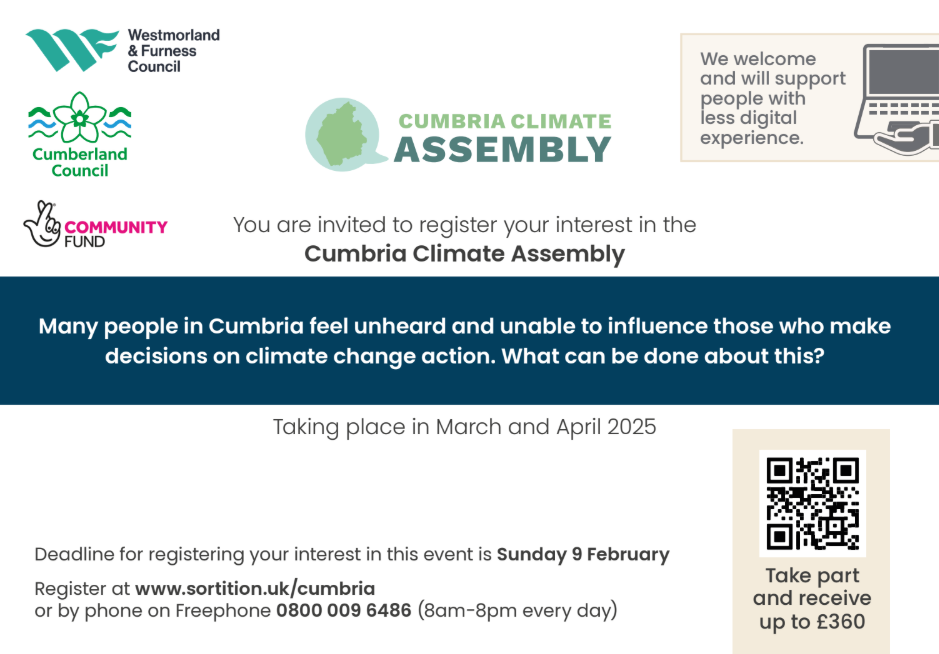
The invitations were open for three weeks, and we received 92 responses.
Stage 2
As part of the sign-up procedure, all potential participants were required to share some information about themselves. We asked them to share their address, their date of birth, their gender identity, their ethnicity and whether they have a disability. We also asked some attitudinal and behavioural questions, namely their attitude towards climate change; whether they had voted in an election; if they had signed a petition; if they had written to their MP; whether they had been involved with a political party; if they had organised in their local community; and if they had taken part in a street protest. We then used this information to perform a democratic lottery. Details of the specific algorithm we use, including information about the fairness of the algorithm, can be found here. During the process of confirming participants, people dropped out and they were replaced by lottery to maintain the demographic make-up of the assembly. Below are some of the results, you can download the full set of categories used for stratification here.
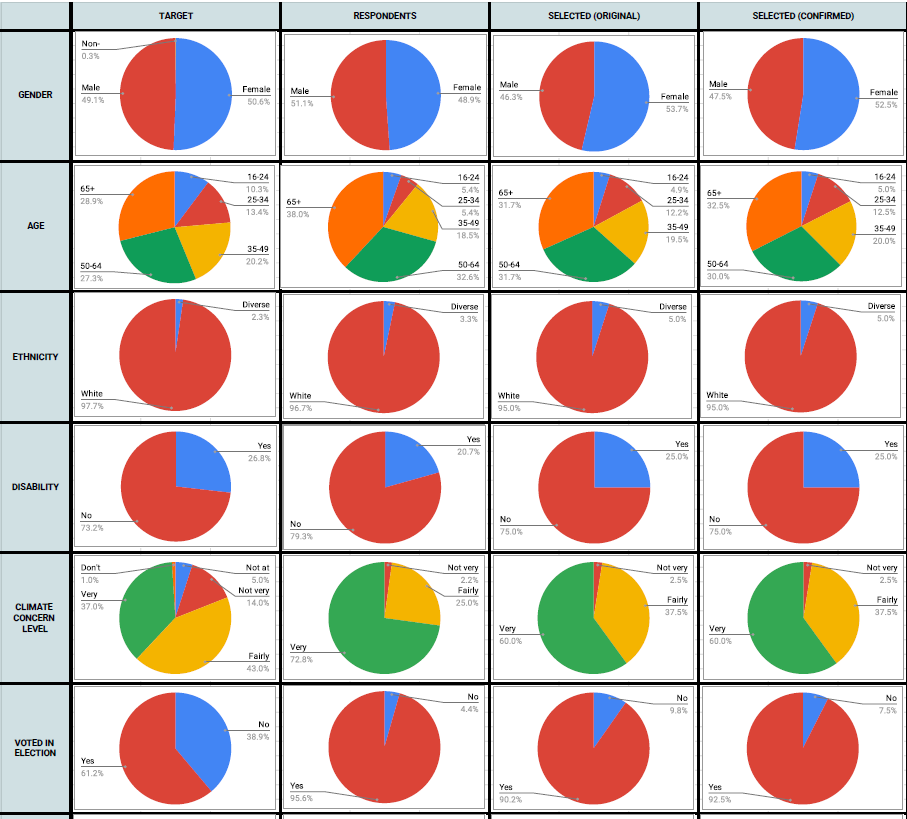
The way to understand these pie charts is as follows:
- Column 1 (Target): These pie charts give information about the population of the area, using various publicly available statistics (via the ONS). As an example, in the second row, you can see that 10.3% of the population of this area is aged between 16 and 21.
- Column 2 (Respondents): These pie charts summarise the information that was provided to us by the 92 people who signed up as potential participants for the Cumbria Climate Assembly. There is some skewing in statistics here compared with our target: for instance, only 5.4% of respondents were aged between 16 and 21.
-
Column 3 (Originally selected): These pie charts summarise information about the 40 members initially invited to be part of the forum. Notice that, thanks to our use of a sortition algorithm, the pie charts in this column are closer to the target charts in the first column. As part of our recruitment process all of these people were contacted by telephone to confirm that they were still willing and able to participate. Not all people, however, were able to confirm their participation, and some dropped out.
-
Column 4 (Final participants): This final column shows the information relating to the 40 people who confirmed their participation. When people dropped out, we used the sortition algorithm to replace them with others who shared similar characteristics, as far as possible.
What happened next?
The report of the Cumbria Climate Assembly is available here.